Bombay Orthopaedic Society: Founding Years – 1965 to 1990
BOS-JCORTH | Journal of Clinical Orthopaedics | Vol 10 | Issue 2 | July-December 2025 | page: 06-08 | Anand J Thakur
DOI: https://doi.org/10.13107/jcorth.2025.v10.i02.754
Open Access License: CC BY-NC 4.0
Copyright Statement: Copyright © 2025; The Author(s).
Submitted Date: 8 Oct 2025, Review Date: 10 Nov 2025, Accepted Date: 20 Nov 2025 & Published Date: 10 Dec 2025
Author: Anand J Thakur [1, 2]
[1] Irla Nursing Home, 189 S V road, Irla, Vile Parle West, Mumbai, Maharashtra, India.
[2]Formerly Hon. Orthopaedic surgeon, Cooper Hospital, Juhu, Mumbai, Maharashtra, India.
Address of Correspondence
Dr. Anand Thakur,
Formerly Hon. Orthopaedic surgeon, Cooper Hospital, Juhu.Mumbai
Irla Nursing Home, 189 S V road, Irla, Vile Parle West, Mumbai, Maharashtra, India.
Email: thakurajt@gmail.com
In the early 1960s, a dozen or so surgeons were exclusively practicing orthopedics in Mumbai. They were busy serving the needy patients, but had little academic interaction. Dr. A K. Talwalkar had initiated a travelling fellowship for Indian orthopedic surgeons. Sir Herbert Sedon visited Mumbai in 1962 and held clinical meetings at three medical colleges. This created academic enthusiasm among 20 or so orthopedic surgeons actively practicing in Mumbai. The need for a professional society to stay up-to-date in the subject and disseminate orthopedic knowledge and expertise led Bombay’s surgeons to come together in the last quarter of 1964. Under Dr. A K. Talwalkar’s leadership, periodic clinical meetings were held; Dr. L N. Vora was the organising secretary.
In the early days of 1965, the British Orthopaedic Association chose R J Katrak as its honorary fellow, the only orthopedic surgeon from India to receive such an honor. The newly formed group used the occasion to formalize the formation of their professional society and commemorate the unique academic event by instituting the Dr. R J. Katrak Oration. Dr. R J Katrak was the first president of the society, and L N Vora was the founding secretary. In 1965, Mumbai had a brand-new professional society, the first of its kind and an oration that grew in stature over the years. The Indian Orthopaedic Association was already established under the umbrella leadership of the Association of Surgeons of India (ASI); there was no other orthopedic association at the time.
Founding members were Drs. R J Katrak, M G Kini, A K Talwalkar, K T Dholakia and K S Masalawala. Dr. (Miss) P K Mullaferoze, M A Vali, G S Chawra, R M Bhansali, J C N Joshipura, M V Sant, S K Bulcahndani, Gaitonde, K V Chaubal, B B Joshi, Maj. Gen. L K Anantnarayan, L N Vora, M N Shahane, A V Bavdekar, S K Bhandare, C J Pradhan and D D Tanna; Dr. D D Tanna is the last surviving founding member. Later, orthopedic surgeons from Gujarat, Maharashtra, and coastal Karnataka joined the academic activities.
On November 19, 20, 1966, the first Western India Regional Orthopaedic Conference (WIROC(R)) was held in CVTC-KEM Hospital, Parel, Mumbai 400012 over 2 days. Dr. Arthur De Sa, president of ASI, inaugurated the 1st WIROC. Dr B Mukhopadhyay of Patna delivered the first R J Katrak Oration: “Use and Abuse of Metal”. The annual event was held alternately in Mumbai and at neighboring cities, including Ahmedabad, Vadodara, Surat, Mahabaleshwar, Mt. Abu, Nashik, and Solapur. Maj. Gen. L K Anant Narayan hosted the fourth meeting in a military environment of the Armed Forces Medical College, Pune. Dr. Talwalkar’s bungalow in Pune was the venue for the conference banquet. The last meeting outside Mumbai was also held in Pune on 22 and 23 November 1986 at Sancheti; Dr. Ajit Damle was the organizing secretary. The Dr. A K Talwalkar Prize for the best paper at these conferences was the highlight that brought out excellence in the younger members of the profession.
Two-monthly clinical meetings were the backbone of the society’s activities. All the orthopedic surgeons in Mumbai used to attend. The residents honed their presentation skills in describing the clinical findings of a case, which was then freely discussed. Whenever the common discussion ended in a directive for further management, Dr. A K Talwalkar made a point to ask the local surgeon to present his results at the next meeting at the same hospital. Sure enough, he would remember the case in the next round. The host clinicians used audiovisual equipment for the 1st time to present data at Dr. R N Cooper Hospital; another first was that the Bombay Orthopaedic Society (BOS) held its clinical meeting outside the medical college circuit and away from Mumbai city. The tea breaks were stylish snacks in decent porcelain cups and saucers, accompanied by crispy biscuits and tasty chutney sandwiches; the local chief paid the bill. After the meeting, which concluded around 1 o’clock, all participants attended a lunch held at a nearby restaurant. The meetings were held in Mumbai city, primarily at KEM Hospital, JJ Hospital, Nair Hospital, Children’s Orthopaedic Hospital, and the Central Government Rehabilitation Centre. The lunch was often at Kemp’s Corner. The lunch was contributory. However, the President provided the booze. Dr. A K Talwalkar was the first president to do so.
The second activity was of postgraduate teaching. Individual teachers held clinics late in the afternoon or evening for the postgraduates. This activity was teacher-oriented and gained momentum closer to the examination days. BOS then initiated a lecture program for postgraduate students, which was held twice a year. Didactic lectures were held over 2 days. The initial venue was Wadia Children’s Hospital. Where the nurses’ auditorium and nurses’ mess offered a peaceful environment.
The clinical meetings were initially irregular in frequency and were held as and when it suited the secretary; there was no regular program for the society until 1979. The BOS published the first calendar of events around 1980. It was a fanfold affair, and we used both sides to highlight and advertise the dates of the clinical meetings and postgraduate teaching program. A year later, the first BOS wall planner was published. The first specialized teaching program, “Hand Surgery for Orthopaedic Surgeons” was conceived and held by Dr B.B. Joshi at MGM Hospital, Parel, in 1981.
In 1972, in collaboration with E Merk and Co., we started the “Bombay Orthopaedic Society and Neurobion Mark Fellowship”; Dr A K Talwalkar was the chief motivator in securing cooperation of the pharma company. Two young orthopedic surgeons from anywhere in India are to spend a month in Mumbai and study the work here every alternate year. The other year, two young orthopedics from Western India visited centers in other parts of the country.
Not content with these activities, the society added an annual refresher course for young orthopedic surgeons in 1979, focusing on techniques of fracture treatment and fixation. The same year, we established a photographic slide and audio-tape library, courtesy of Dr K S Masalawala, to help teachers and students pursue studies in orthopedics. The society was associated with establishment and running of Bone Tumor registry and works at the J J Hospital; trauma ambulance service at Sion hospital for speedy and safe transport of severely injured patients; Rheumatic arthritis clinic at Nair hospital, research in rehabilitation technique at KEM Hospital, Polio and Cerebral palsy management at Children’s Orthopaedic Hospital, Haji Ali and All India Institute of Physical Medicine and Rehabilitation also at Haji Ali, Mumbai.
Dr. A K Talwalkar stands out as an outstanding leader to promote new and innovative teaching activities for orthopedic surgeons in BOS and nationwide. His enthusiasm for new teaching activities remained unabated, even in his advanced years (Fig. 1).
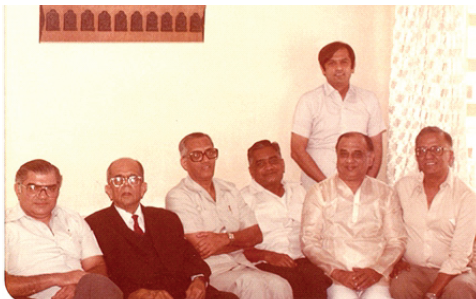
Figure 1: Dr. A K Talwalkar’s letter to start a M.Ch. like course under BOS. The meeting of the governing body to approve his suggestions. From left to right: Drs. M N Shahane, A K Talwalkar, K V Chaubal, C G Pradhan, S J Kumbhani, President, W G Ramarao, Standing: Anand J Thakur, Secretary.
The society maintained an atmosphere from the beginning where young and old, radical and conservative, discussed orthopedics in a free and fearless atmosphere, later mixing it with goodwill and humor. As a result, legendary orthopedic picnics were as much a part of the professional fabric as academic discussions. (Fig. 2)
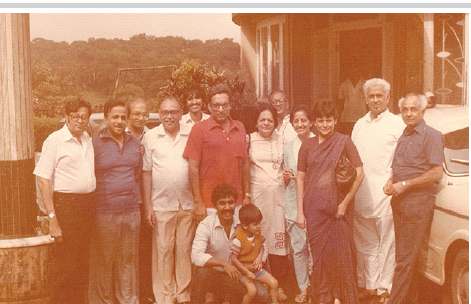
Figure 2: Picnic at Lonavala. From left to right: Atul Modi, Shabbir Choonia, Naveen Shah, B B Joshi, Unidentified, D D Tanna, Bindu Vora, W G RamaRao, Manju Tanna, Urmila Thakur, L N Vora, G S Chawra. Sitting: Ashok Maniar, Kanishka.
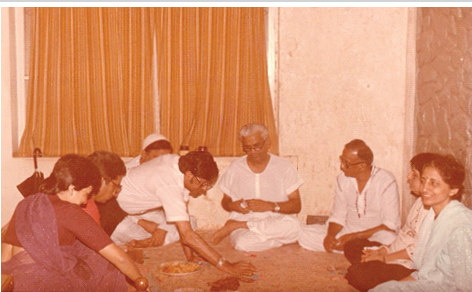
Figure 3: Inevitable gaming session. From left to right: Urmila Thakur, D D Tanna, Atul Modi, Shabbir Choonia, L N Vora, W G RamaRao, Bindu Vora, Manju Tanna.
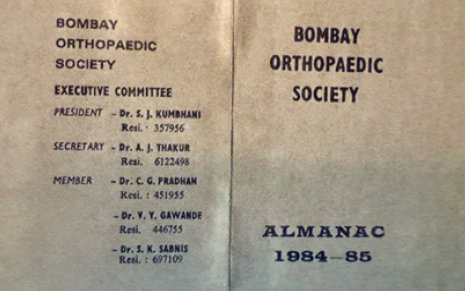
Figure 4: Precursor of Bombay orthopedic society calendar of events: “Almanac”.
Several times a year, the members spent a weekend in nearby esoteric holiday spots, such as hydro-power generating stations, a niche bungalow in Bombay Harbor under the port trust, a hill station location reserved for the exclusive use of upper echelons of Bombay’s industrial elite, and famed seaside locations. It used to be an all-male affair, except on rare occasions, the families too joined.
In the 1970s, Indian book publishers were not interested in Indian medical literature, and foreign publishers hardly considered India a source for new publications. To provide an impetus to writing on the Indian orthopedic scene, BOS proposed to give an encouragement prize to someone who would write a treatise, a glorified term for the then-common format of writing a thesis for the M.S. Exam. Initially, people used to send their modified M.S. thesis with some additional data and viewpoints. In 1986, Dr. P Chacko of Kochi was the 1st to submit such a work, “Compression plating of long bone fracture – a new technique,” and was given the Best Treatise Award. The situation later improved, and we received printed books as well; BOS created a new award for the Best Book of the year. There was a severe shortage of clinical papers in the world literature from India. The Indian Journal of Orthopedics was not as established as it is now; its publication was irregular and erratic, with a paucity of funds being the leading cause. In 1992, the Journal of Bone and Joint Surgery, British volume, published only two papers from India; the American volume never accepted any of our papers. The BOS created the Publications Recognition Award to overcome this lacuna.
In 1980, BOS hosted the Silver Jubilee celebrations of the Indian Orthopaedic Association. In the initial 25 years, there had never been a suitable time to hold that meeting in Mumbai; however, the Silver Jubilee was celebrated in grand style at the Taj Mahal Hotel in Apollo Bunder, Mumbai, with nearly 900 delegates attending from across the nation.
During the initial years, BOS members made substantial contributions to the orthopedic cause at the national level. 7 BOS members served as IOA presidents: A.K. Talwalkar 1959, M V Sant 1965, K T Dholakia 1967, K S Masalawala 1970, L K Ananthanarayanan 1974, B B Joshi 1979. Dr. W G. Ramarao served as the secretary from 1979 to 1981. Dr. A K Talwalkar, on a personal level, engaged with Johnson and Johnson to establish a national travelling fellowship for Indian orthopedic surgeons. In Mumbai, Dr. Talwalkar hosted the fellows at his expense, and he continued to lead the program between 1963 and 1973. Later, Dr. W G Ramarao led from 1974 to 1978. Dr. A K Talwalkar also organized a Smith and Nephew U K travelling fellowship for Indian Orthopedic surgeons.
The Bombay Orthoptic Society celebrated its silver jubilee in 1989 at the Taj Mahal Palace Hotel, Mumbai. Dr. Vijay Gavande was the secretary.
Over the first 25 years, the society experienced robust growth in all aspects of orthopedic surgery. It helped in the dispersal of orthopedic knowledge in a very special way, elegantly expressed as:
एक हमीं हैं जो आँखों से पिलाते हैं
यू कहने को दुनिया में मयख़ाने हज़ारों हैं —शहरयार
| How to Cite this Article: Bombay Orthopaedic Society: Founding Years – 1965 to 1990. Journal of Clinical Orthopaedics. July-December 2025;10(2):6-8. |
(Article Text HTML) (Download PDF)